Zhengzhou Success Machinery Co.,ltd - Professional valve manufacturer

News Center
One-stop Solution for Valve Products
News Events
Latest News

Double-Plate Wafer Check Valves VS Single-Plate Wafer Check Valves
Release time:
Sep 15,2025
Check valves are an extremely important type of valve, primarily used in piping systems to prevent backflow of fluid. Single-plate and double-plate check valves represent two common types of check valve, exhibiting distinct differences in design, operating principles, and application.
Double-Plate Wafer Check Valves VS Single-Plate Wafer Check Valves
Single-plate check valves typically comprise a single plate, fixed to the valve bonnet. The valve opens and closes through the rotation of this plate. When fluid flows in the forward direction, the plate rotates upwards, opening the valve to allow free passage of fluid. When fluid flows in the reverse direction, the plate is subjected to back pressure from the fluid, causing it to rotate downwards and close the valve, thereby preventing backflow. The single-plate check valve offers advantages of simple construction and ease of maintenance, making it suitable for low-velocity, high-pressure pipeline systems. However, its drawback lies in incomplete closure, presenting a potential for leakage. Furthermore, during high-velocity fluid flow or high-volume conditions, insufficiently rapid valve closure may adversely affect pipeline system operation.

The double-plate check valve consists of two plates. with the fixed plate secured to the body. Valve operation is achieved through rotation of the actuating plate. When fluid flows in the forward direction, the plate rotates upwards and open the valve to allow free passage. When fluid flows in the reverse direction, the actuating plate is subjected to the fluid's reaction force, rotating downward to close the valve and prevent backflow.
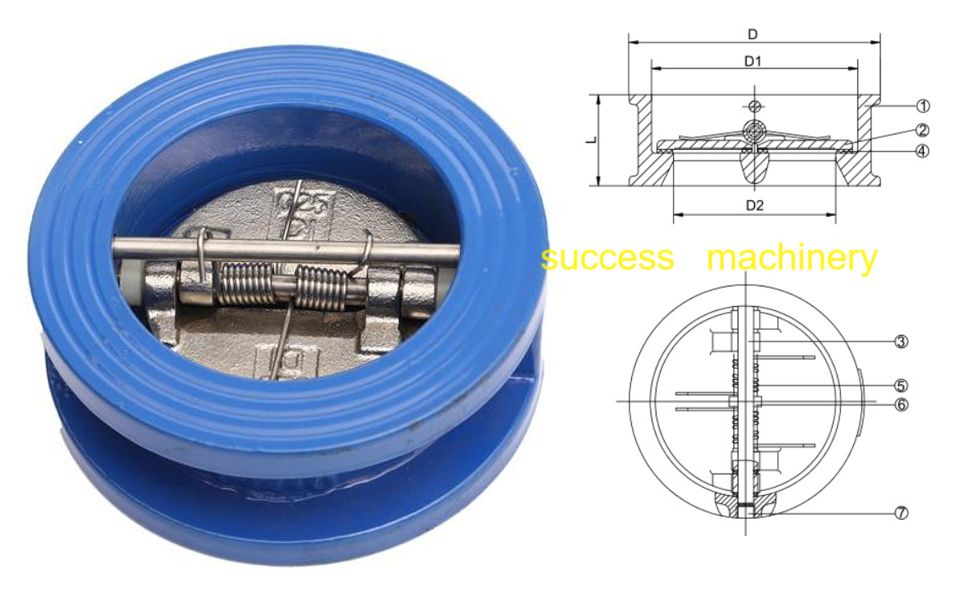
The advantage of the double-plate check valve lies in its more thorough closure, offering superior leak prevention, making it suitable for high-velocity and high-pressure pipeline systems. Furthermore, it achieves faster valve closure under high-speed fluid flow or large flow rates, the valve closes more rapidly, without compromising the operational efficiency of the pipeline system. However, its drawbacks include a relatively complex structure, higher cost, and the generation of some noise and vibration when fluid flows in the opposite direction.
When selecting between single-plate check valves and double-plate check valves, factors such as fluid characteristics, flow velocity, and pressure must be considered. Generally speaking, for pipeline systems with low flow velocity and low pressure, a single-plate check valve suffices; for systems with high flow velocity and high pressure, a double-plate check valve is more suitable. Additionally, single-plate check valves are suitable for unidirectional flow applications, whilst double-plate check valves are designed for bidirectional flow scenarios.
In summary, single-plate check valves and double-plate check valves are two common types of check valve. They have certain differences in design, operating principles, and application. When selecting which check valve to use, a comprehensive assessment of the specific pipeline system conditions is required. Factors such as fluid characteristics, flow velocity, and pressure must be considered to arrive at a sound decision.
keywords

Follow Us
Zhengzhou Success Machinery Co.,ltd
TEL:+8618595868771
E-mail:sales@successmach.com
Address:98-1 Dengfeng Road, Shangjie District, Zhengzhou City, Henan Province